Universe’s Children
Aaliyah C.
Author
Aaliyah C.
Category
Review
Subject
Sound art, digital art
Artists Featured
Yuwan
Yuwan Zhang is open to any style of collaboration and discovery in any art form, including collaboration on the LGBT+ topic.
Dec 9, 2025, 12:00 AM
In Universe’s Children, the artist composes a world where humanity, nature, and the cosmos do not simply coexist but circulate through one another. The work imagines the human body as a porous vessel, shaped by the earth beneath it and the sky above it. What emerges is neither a traditional musical composition nor a ritual in the conventional sense, but a space of resonance where language, breath, and cosmological imagination converge.
The artist begins from a premise both ancient and radically contemporary: that human beings are not observers of the universe but participants within it. This idea, which once belonged to cosmologies across civilizations, reappears here in a new form. The voice becomes the conduit through which human and non-human worlds meet. Rather than employing fixed linguistic meaning, the artist dissolves language into pure sonic matter. Fragments of Latin chant, dream-born Chinese syllables, Japanese lullaby phrases, and invocations shaped by Egyptian and Arabic phonetics intermingle. The result is an array of utterances that suspend semantic function and instead act as emotional frequencies. Meaning becomes fluid, distributed, and co-created between the artist and each listener.
This hybrid language is not an archive of world cultures but a living organism. It shifts between the sacred and the untamed, reflecting the dual nature of humanity. In the vocal performance, the artist moves between refinement and rawness, unveiling a voice that carries both invocation and vulnerability. The divine is never detached from the wild, and the wild is never devoid of tenderness. Through this interplay, the human voice becomes a point of entry into larger ecological and cosmic cycles.
The work extends its inquiry through instrumentation drawn from disparate geographies and histories. Japanese kagura suzu, Korean shaman bells, Tibetan cymbals, Cyprus church bells, and choral practices rooted in liturgy are placed beside symphonic textures and electrified instruments. These sounds articulate a condensed timeline of civilization. They remind us that ritual, science, religion, and technology are not separate chapters but interwoven responses to the same existential question: how does a small human being locate themselves within an infinite universe?
Technology appears here not as an intruder but as a continuation of nature. The artist’s use of sample libraries highlights this position. In their view, the digital archive of instruments is an environment as natural as any forest or mountain, because creativity unfolds through whatever tools are available within a given era. Technology expands the human palette and extends the imagination without erasing the human hand. This distinction is crucial to the artist. A tool that amplifies human intention remains part of creative lineage. A tool that replaces human intention becomes a matter of authorship and ethics. The work situates itself squarely in the former category, treating digital mediation as a partner rather than a surrogate.
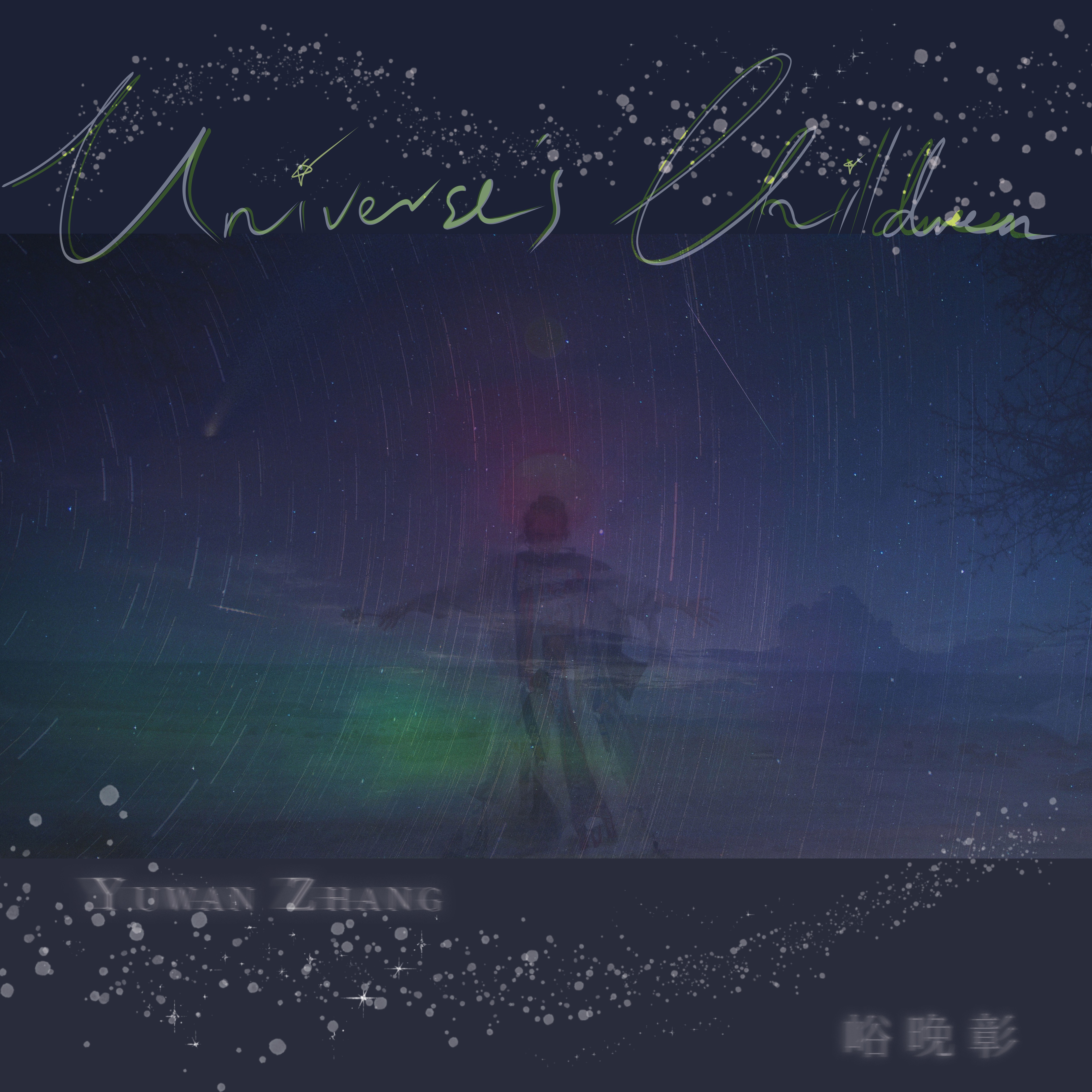
The visual language of the poster strengthens the cosmological dimension of the piece. The imagery draws from years of footage captured by the artist: auroras, meteor trails, sunrise haze, desert horizons, lake reflections, layered cloudscapes, and lunar light. These natural scenes are intercut with the figure of the artist in a graduation robe that resembles the cloak of a sorcerer. The body moves through wind, water, and starlight, casting spells with a kagura suzu. One version of the self walks toward the dusk clouds, while another remains indistinct, almost faceless. The absence of facial detail is deliberate, for the figure is not an individual identity but a silhouette open to all. Anyone can inhabit the role of the universe’s child.
The poetic and philosophical foundation of the work traces back to the artist’s lived memories. At six years old, the night sky of Nyingchi opened a portal of astonishment. Years later, inside the Griffith Observatory in Los Angeles, the revelation that galaxies extend far beyond our own turned science into a form of existential tenderness. Visiting LACMA’s Mapping the Infinite exhibition in 2025 reactivated this sensibility, revealing a tapestry of cosmologies that echoed across cultures and epochs. These moments form the emotional substrate of Universe’s Children. They bind together wonder, fragility, and the profound recognition that to exist is to participate in an incomprehensibly vast system.
At its core, the work proposes a cosmology of connection. Sound becomes a medium through which history circulates, nature becomes a parent rather than a backdrop, and the universe becomes not a distant abstraction but a home. The piece asks us to imagine ourselves not as isolated beings but as participants in a shared cosmic lineage. To be human is to be nature, and to be nature is to be part of the universe’s ongoing story.
Universe’s Children is both an offering and an invitation. It calls for a renewed understanding of belonging, one that dissolves the boundaries between language and emotion, ritual and technology, memory and matter. Through voice, instrument, and image, the artist reminds us that we are, and have always been, children of the universe.
About the Artist
As a media composer, vocalist, and sound artist, Yuwan’s creativity is highly versatile. Yuwan’s musical style is strongly melodic and uses voice and other elements to connect with “Humans”, the audience.
Coming from a multicultural background, Yuwan is passionate about exploring world music and discovering new timbres by featuring a wide range of traditional instruments, weaving themes of identity, meaning, and time naturally into the projects.