


B*O/D&Y
B*O/D&Y explores the body as a site of transformation, where glitches, systems, and technologies reveal new forms of identity and perception.


“We are all chimeras, theorized and fabricated hybrids of machine and organism.”
— Donna Haraway
The body is often imagined as the most immediate form of human existence: intimate, natural, and autonomous. Yet contemporary life reveals the body to be anything but independent. It is measured by algorithms, shaped by infrastructures, disciplined by social systems, modified through technologies, and entangled with ecological crises beyond individual control. The body is no longer simply where experience takes place; it has become a contested space where systems of power, identity, and transformation operate.
B*O/D&Y, produced by SPIRA9 ART hosted by Gallery 46, begins from this unstable condition. The exhibition examines the body through its points of rupture - moments when established structures fail to maintain their appearance of continuity. Rather than presenting instability as a weakness, B*O/D&Y positions fracture, malfunction, repetition, and distortion as critical states through which contemporary realities become exposed.
At the centre of the exhibition is the concept of the glitch. Commonly associated with technological error, the glitch is often treated as something temporary: a malfunction awaiting correction, an interruption to an otherwise perfect system. B*O/D&Y challenges this assumption. The glitch is understood here as a form of revelation - a moment when systems disclose their own limitations, contradictions, and hidden mechanisms.
The works brought together in the exhibition refuse the idea of the body as a complete or stable entity. Instead, bodies appear as fragmented, hybrid, mediated, and continuously reconstructed. They exist between biological matter and technological interface, between personal memory and collective history, between individual agency and larger systems of control.
In an era where images, data, and biometric information increasingly define how bodies are recognised and valued, visibility itself has become a form of power. Technologies promise greater connection and self-expression while simultaneously producing new forms of surveillance, classification, and regulation. The body becomes both participant and subject of these systems: something that is represented, analysed, consumed, and transformed.
B*O/D&Y questions what remains of embodiment when experience is increasingly translated into digital information. If identity can be edited, reproduced, simulated, and circulated, where does the boundary between the physical and the constructed begin? The exhibition does not seek to restore an imagined authentic body before technology, but instead examines the complex realities produced through technological entanglement.
Beyond the human body, the exhibition expands embodiment into ecological, material, and non-human territories. Bodies exist within landscapes, infrastructures, and environments that constantly shape and reshape them. The separation between human and non-human, natural and artificial, organic and mechanical becomes increasingly unstable. This instability reflects a contemporary condition in which survival itself depends on recognising forms of connection that modern systems have historically attempted to divide.
Materiality becomes a form of resistance throughout the exhibition. Surfaces carry evidence of pressure, erosion, repetition, and transformation. Objects and materials are not passive containers of meaning; they retain histories of contact and intervention. Through accumulated traces, altered forms, and transformed substances, the exhibition reveals how bodies and environments are continuously written upon by forces both visible and invisible.
Time also operates differently within B*O/D&Y. Against dominant narratives of progress, efficiency, and optimisation, the exhibition considers repetition, delay, suspension, and incompletion as meaningful conditions. A loop is not simply a failure to move forward; it can expose the structures that determine movement itself. Waiting is not absence; it can become a heightened awareness of change. Fragmentation is not disappearance; it can reveal new relations between parts.
The exhibition further considers how bodies are shaped by social histories and political structures. Questions of migration, labour, gender, illness, memory, and cultural identity demonstrate that embodiment is never purely personal. Every body carries external forces: inherited narratives, institutional expectations, and systems that determine whose bodies are protected, represented, or excluded.
Through diverse contemporary practices, B*O/D&Y proposes that instability is not a temporary condition but a defining feature of the present. The body is no longer understood as a fixed boundary separating self from world, but as a dynamic site of negotiation - vulnerable yet adaptive, fragmented yet generative.
The glitch does not represent the collapse of the system.
It reveals that the system was never as stable as it appeared.




When Donna Haraway famously declared that “we are all chimeras, theorized and fabricated hybrids of machine and organism,” she was pointing toward an uncomfortable truth: the human body has long ceased to be a pure, sovereign territory. In B*O/D&Y—hosted by Gallery 46 and produced by SPIRA9 ART—this hybrid reality is laid bare. The exhibition refuses to mourn a lost organic authenticity, nor does it celebrate a slick, friction-free posthuman future. Instead, it locates its power in the glitch—that precise moment where systems of control, technology, and biology fracture, exposing the hidden machinery underneath.
What follows is an exploration of the forty artistic voices in the show, mapped out as a continuous critical journey through the exhibition's contested terrains.
The Screened Interface and the Digital Skin
The exhibition opens where the physical world bleeds into digital mediation. In Alexander Collinson & XinYue Ma’s Residual Current, a metallic-glazed ceramic bowl becomes an aperture for a video depicting a submerged sea-defence pole at the River Blackwater. The tactile, ancient weight of fired clay acts as a vessel for digital light, letting landscape and memory wash over one another like an incoming tide. This quiet synthesis immediately ruptures in Ananya R’s I Am, where datamoshed photogrammetry, 3D skulls, and synthetic voices dissolve identity into an unstable algorithmic loop. Here, the glitch ceases to be a technical error; it becomes the primary condition of selfhood, hovering uneasily between biological decay and artificial intelligence.
Where Ananya R turns to digital disintegration, Anita Memar’s Beyond the Shadow anchors this collapse in the tangible endurance of air-dry clay. Under hand-applied patina and shifting light, her fractured forms demonstrate that rupture is not an end point, but a fragile threshold where transformation begins. This material meditation shifts into painterly gesture in Brina Elizabeta Blaz’s Untitled, where oil and pigment on paper abstract the written word into a expressive, moving surface. Text loses its cold, communicative function and becomes a mystic, bodily rhythm.
In Christoph Koch’s Die Wartende, motion gives way to an expectant pause. Using rain as an unyielding metaphor for time, the video considers the paradox of waiting—proving that while the subject appears passive, decay and transformation are continuously unfolding. This quietude is shattered by Claudia Ungersbäck’s Stalkerpicture, which hurls us directly into the panoptic gaze. A fragmented face merged with a smartphone lens—captured via a flatbed scanner—exposes how identity is processed, flattened, and consumed within modern systems of surveillance.
Clinical Gazes, Pressures, and the Dysmorphic Mirror
Moving beyond the screen, the exhibition interrogates how bodies are disciplined by medical and social architectures. Cynthia Weber’s Crohn’s Is the Spine of Me constructs an intimate, visceral archive of chronic illness. A likeness of her spine—assembled from wood, medication injector caps, and sewing clips—hangs alongside diagnostic clipboards, turning medical misjudgment into a quiet monument of resistance against clinical coldness.
A gentler, yet deeply haunting material memory appears in Diqiu Wang’s Traces of Home 1 & Traces of Home 2. Gelatin plate transfers and erased pencil lines transform the textures of old domestic objects into faint, bodily impressions, proving that memory lives on in the worn surfaces of the everyday. Physical tension hardens again in Elizabeth Benson’s Compression IV & Compression X, where bound and folded textiles record rust marks and gravitational pressure, treating cloth as a surrogate skin shaped by restraint.
This external pressure turns inward in Fernando Jiménez Fierro’s Body Dysmorphia. A self-portrait reshaped by photo editing software and social media filters lays bare the psychic weight of digital self-consumption, where the drive for algorithmic perfection fractures self-perception. In response to this isolation, Fia Cavozzi’s Disoriented Together presents a series of merging acrylic-on-cardboard figures with missing and multiplied limbs. By distorting classical ideals of form, the work finds a strange visual truth in disoriented, collective embodiment.
The obsession with physical form reaches a speculative extreme in Garry Young’s Icarus's Event Horizon Ideation. Outfitted with augmented wings in a dystopian future where humans are grown in vitro, this post-human Icarus prepares to fly into a black hole’s Event Horizon, pushing human ambition past biological limits into cosmic mystery.
Ecological Ruptures and Posthuman Geometries
From cosmic ambition, the exhibition turns to terrestrial crisis. Greg Kent’s Ooops! Too late. presents a massive beechwood vessel whose melting form echoes the point of no return in the climate catastrophe. The wood itself seems to weep for an earth in collapse while political systems stand idly by.
"The glitch is not a failure of the system; it is the moment the system discloses its own fragile, hidden mechanisms."
This ecological anxiety finds an algorithmic counterpart in Guli Silberstein’s MATERIALIVE, where generative AI and datamoshing fuse pixels, neural networks, and natural landscapes into a hypnotic visual poem. Here, organic life and computational power dissolve into a shared, chaotic ecosystem. Emerging from this digital tide, Harshala More’s Ecstatic Interference activates under UV light, revealing hidden fluorescent symbolism that draws the viewer into a space between ritual, technology, and altered perception.
A human, witty glitch breaks this intensity in Helen Lom’s My Vegetable Brain. Watercolour on paper transforms a moment of cognitive fatigue into a bowl of salad, capturing with gentle humor the vulnerability of a mind that refuses to function like an optimized computer. Yet, societal expectations quickly reclaim the body in Herbert Neuwirth / Neuart’s Voodoll. By fusing a fashion doll's silhouette with the logic of a voodoo object, the print questions who holds authority over bodily norms and vulnerability.
This tension between structure and flesh reaches an explosive peak in Hongru Zhang’s Fission 0-00-000. Steel, plaster, and latex pull against one another until a silent fission occurs, exposing the raw threshold where skin meets structure, and protection turns into vulnerability.
Systems of Labour, Migration, and Hybrid Belonging
The forces shaping the body are equally political and economic. Huang Jianming’s ASSEMBLY LINE uses X-ray imaging to reveal the personal belongings inside the luggage of overseas Chinese students, transforming intimate objects into scanned data along a global assembly line.
In Jessie Zhai’s Elegies, political ecology adopts a mournful tone. Four digital prints unite human and animal bodies to commemorate creatures lost to human industrial expansion, reflecting our fragile interconnectedness with the natural world.
The digital distortion of portraiture deepens in Julien Fezil’s " RAW_01 " , which marries traditional oil painting with a background derived from glitched photograph data, creating a productive friction between tactile paint and computational error.
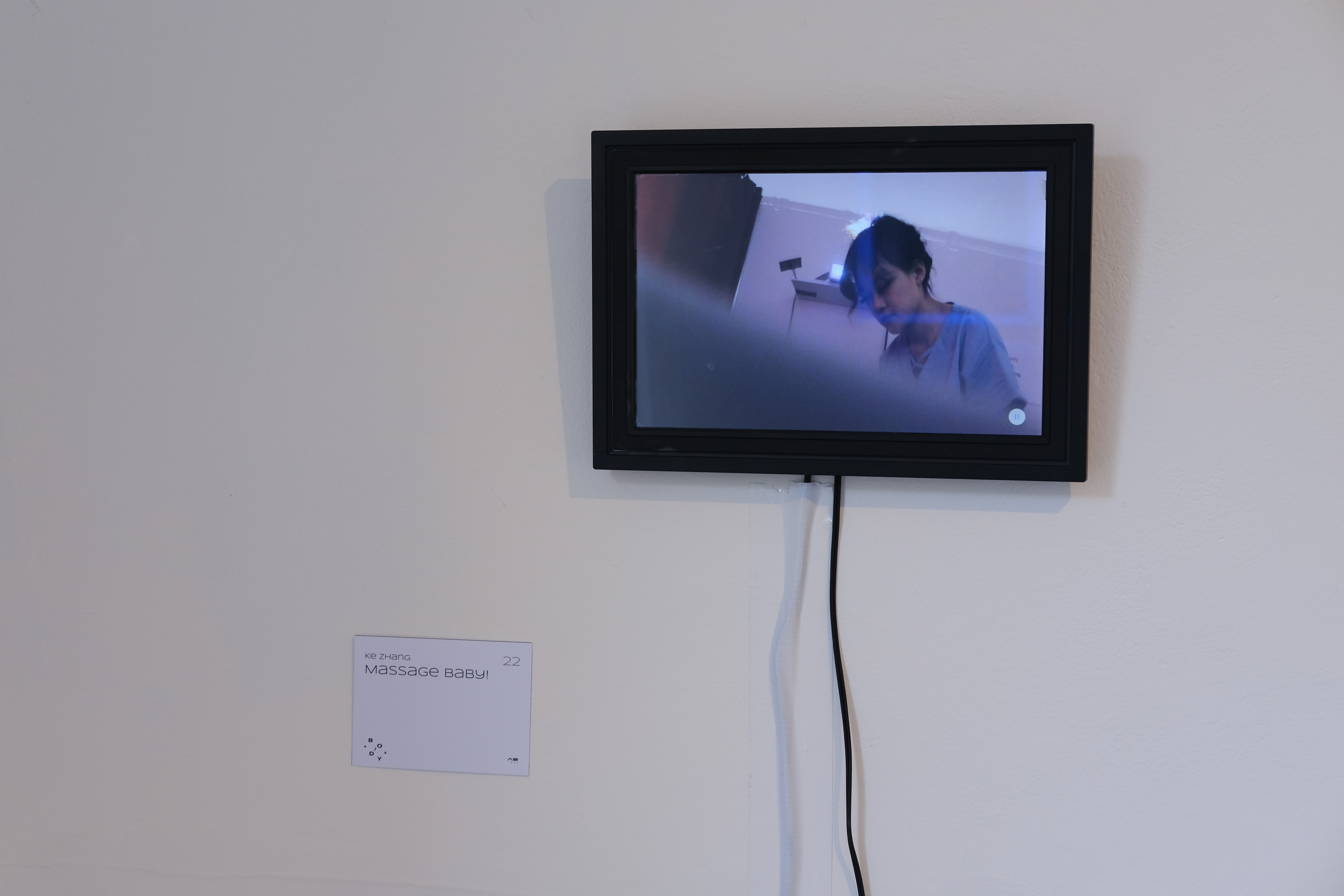
Questions of visibility and labor surface acutely in Ke Zhang’s Massage Baby! (2026). Following a fictional Chinese massage worker in New York, the hybrid documentary examines intimacy, translation, and the power dynamics inherent in being filmed.
In Kun Fang’s Human nature: Anatomical Glitch, the glitch becomes an explicit refuge. Rejecting sterile cyborg tropes, the mixed-media work frames the unstable female body as a defiant organism thriving in the space between euphoria and collapse.
Time and history settle onto the skin in Larissa Maliughina’s Origine & Tempo. Drawing from the fractured surfaces of Pompeii, sculpted plaster and pigments treat time as a physical force that carves memories directly into matter.
Cyclical Embodiments, Rituals, and Intimate Gazes
Looking closely at the body in motion, Laura van Tatenhove’s Bather captures a figure waiting on a diving platform in Rhodes. Dissolved by light and oil paint, the body hovers between stillness and action, reflecting the unstable nature of observation itself.
This fluidity becomes explicitly cyclical in Lily Cobb’s THE CYCLE. Eight circular oil paintings present the menstrual cycle as an ongoing landscape of creation and release, resisting linear narratives in favor of recurring bodily rhythms.
The boundary between life and art is quietly probed in Love & Death art.’s Canvas 1. Two preserved finches rest atop sweeping strokes of ochre and grey oil paint. Part scientific specimen and part abstract painting, it contemplates the fragile line where natural life ends and artistic form begins.
In Maya Beauchamp’s Agony, martyrdom meets contemporary queer grief. Drawing from the legend of St. Sebastian and Derek Jarman’s film Sebastiane, mixed-media layers explore how myth and memory continually rewrite the facts of a life.
Posthuman transformation takes on a tactile, cultural weight in Megumi Ohata’s Haori. Imprinted with the artist’s own skin texture, this wearable silicone sculpture draws on folklore and yōkai to explore displacement, trauma, and the shedding of human limitations.
This deeply felt physical reality contrasts with the clinical coldness critiqued in Mouse Terry’s Heartburn. Bold acrylic forms depict interoception—the internal sensory awareness of our organs, exposing the disconnect between what it feels like to live inside a body and how medical imaging coldly presents it.
Reclaimed Geometries and the Final Glitch
Emerging from clinical abstraction, Olanike’s Marked celebrates the vitiligo body through digital portraiture. Reframing difference as empowerment, the work shifts the narrative from medical correction to visibility, dignity, and pride.
In Ombeline Defrance’s We've crossed, intimate connection is re-imagined through the female gaze. Intertwining bodies balance vulnerable affection with active agency, echoing sacred art while establishing a sanctuary of equal desire.
The toxicity of human consumption manifests visually in Ornela Pérez’s 07458/9. Discarded plastic wrappers and fishing nets recovered from urban waste are stitched into a dense, lure-like surface, drawing viewers toward the seductive yet poisonous reality of our throwaway culture.
The line between genetic code and digital code blurs in Rae Piper’s More than Binary - Code for Human. As painted features fragment across the canvas, the figure occupies a liminal space, questioning whether human identity will survive or dissolve in the digital glitch.
This existential question finds a deeply personal anchor in Sarah Pardi’s Blue Kool-Aid. A vivid memory of the artist’s brother dyeing his hair in a crowded family bathroom becomes a poignant meditation on youth, working-class resilience, and the shifting nature of memory over time.
Anxiety takes on a relentless, mechanical momentum in Silke Paulina Markel’s Franz „The Runner“. Crafted from animal bones, wire, and polymer clay, this uncanny figure embodies the restless fear of standing still—a body driven by the frantic impulse of perpetual movement.
Domestication expands into an organic landscape in Tara Shree’s Traces of Shape. Vibrant acrylic washes transform the home into a living organism that absorbs time, holds memory, and records the subtle weight of daily existence.
The construction of sensationalized media narratives comes under harsh critique in Una Kincaid’s Portuguese Holiday. Set within a piano frame wrapped in scratched dust sheets, shrinking oil portraits critique how public tragedy is edited, distorted, and consumed by media systems.
Ecological urgency freezes into a haunting tableau in Victoria Gong’s Amberstiche. Hybrid human-animal forms suspended in 3D animated amber frame fossilization not as passive preservation, but as a frozen, unresolved suspension between life and death.
Finally, Yixuan You’s OUCH confronts the subjective sensation of pain. Questioning cultural demands for quiet endurance, the moving image translates internal suffering into an unavoidable visual encounter, forcing an immediate, shared confrontation with human vulnerability.
The Revelatory Glitch
Across these forty encounters, B*O/D&Y demonstrates that our contemporary condition is defined not by seamless unity, but by generative instability. We are, as Haraway observed, chimeras, spliced from data streams, social codes, ecological realities, and fragile flesh.
When the system glitches, it does not mark the collapse of the body. It reveals that the system was never as stable as it appeared.


Invited Artists
Alexander Collinson & XinYue Ma
Ananya R
Anita Memar
Brina Elizabeta Blaz
Christoph Koch
Claudia Ungersbäck
Cynthia Weber
Diqiu Wang
Elizabeth Benson
Fernando Jiménez Fierro
Fia Cavozzi
Garry Young
Greg Kent
Guli Silberstein
Harshala More
Helen Lom
Herbert Neuwirth / Neuart
Hongru Zhang
Huang Jianming
Jessie Zhai
Julien Fezil
Ke Zhang
Kun Fang
Larissa Maliughina
Laura van Tatenhove
Lily Cobb
Love & Death art
Maya Beauchamp
Megumi Ohata
Mouse Terry
Olanike
Ombeline Defrance
Ornela Pérez
Rae Piper
Ran
Sarah Pardi
Silke Paulina Markel
Tara Shree
Una Kincaid
Victoria Gong
Yixuan You
Produced by: SPIRA9 ART
Curators: Hui Qi
Venue: Gallery 46, London
Curatorial Assistant: Liu Yongyu, Jiaqing Chen
Exhibition Photography: DeiDei @deideipho
Graphic Design: Noah Ellis, Luca Moretti
Exhibitions Coordinator: Sophie Caldwell, Oliver Elstob